
Mouse Secondary Antibodies

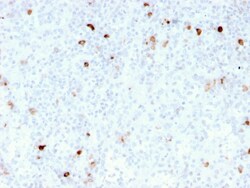
Biotium IgM (Immunoglobulin Mu Heavy Chain) (B-Cell Marker)(rIM260), CF405S conjugate, 0.1mg/mL
Recognizes a protein of 75 kDa, identified as mu heavy chain of human immunoglobulins. It does not cross-react with alpha (IgA), gamma (IgG), epsilon (IgE), or delta (IgD), heavy chains, T-cells, monocytes, granulocytes, or erythrocytes. This MAb is useful in the identification of leukemias, plasmacytomas, and certain non-Hodgkin's lymphomas. The most common feature of these malignancies is the restricted expression of a single heavy chain class. Demonstration of clonality in lymphoid infiltrates indicates that the infiltrate is clonal and therefore malignant. Primary antibodies are available purified, or with a selection of fluorescent CF Dyes and other labels. CF Dyes offer exceptional brightness and photostability. Note: Conjugates of blue fluorescent dyes like CF405S and CF405M are not recommended for detecting low abundance targets, because blue dyes have lower fluorescence and can give higher non-specific background than other dye colors.

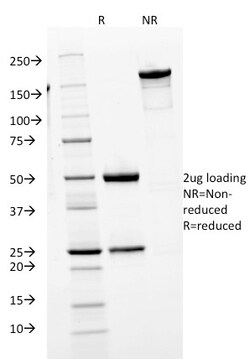
Biotium Human IgM (Immunoglobulin Mu Heavy Chain) (B-Cell Marker)(IGHM/1623), 1mg/mL
Recognizes a protein of 75 kDa, identified as mu heavy chain of human immunoglobulins. It does not cross-react with alpha (IgA), gamma (IgG), epsilon (IgE), or delta (IgD), heavy chains, T-cells, monocytes, granulocytes, or erythrocytes. Monomeric IgM is expressed as a membrane bound antibody on the surface of B cells and as a pentamer when secreted by plasma cells. IgM antibody is prominent in early immune responses to most antigens. Aberrant levels are associated with immune deficiency states, hereditary deficiencies, myeloma, Waldenstrom's macroglobulinemia, chronic infection and hepatocellular disease. This MAb is useful in the identification of leukemias, plasmacytomas, and certain non-Hodgkin's lymphomas. The most common feature of these malignancies is the restricted expression of a single heavy chain class. Demonstration of clonality in lymphoid infiltrates indicates that the infiltrate is clonal and therefore malignant. Primary antibodies are available purified, or w
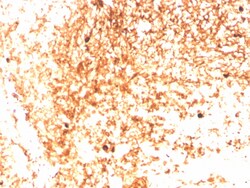
Biotium Human IgM (Immunoglobulin Mu Heavy Chain) (B-Cell Marker)(IGHM/3803R), CF594 conjugate, 0.1mg/mL
Recognizes a protein of 75 kDa, identified as mu heavy chain of human immunoglobulins. It does not cross-react with alpha (IgA), gamma (IgG), epsilon (IgE), or delta (IgD), heavy chains, T-cells, monocytes, granulocytes, or erythrocytes. Monomeric IgM is expressed as a membrane bound antibody on the surface of B cells and as a pentamer when secreted by plasma cells. IgM antibody is prominent in early immune responses to most antigens. Aberrant levels are associated with immune deficiency states, hereditary deficiencies, myeloma, Waldenstrom's macroglobulinemia, chronic infection and hepatocellular disease. This MAb is useful in the identification of leukemias, plasmacytomas, and certain non-Hodgkin's lymphomas. The most common feature of these malignancies is the restricted expression of a single heavy chain class. Demonstration of clonality in lymphoid infiltrates indicates that the infiltrate is clonal and therefore malignant. Primary antibodies are available purified, or w

Biotium Neurofilament (H+L)(RT-97 + NR-4), 0.2mg/mL
This MAb reacts with a 200 kDa and 68 kDa protein, identified as heavy and light sub-units of neurofilaments (NF-H & NF-L). Neurofilaments make up the main structural elements of axons and dendrites and are found in neurons, peripheral nerves, and sympathetic ganglion cells. Neurofilaments consist of three major subunits with molecular weights of 68 kDa (NF-L), 160 kDa (NF-M) and 200 kDa (NF-H). Anti-neurofilament stains a number of neural, neuroendocrine, and endocrine tumors. Neuromas, ganglioneuromas, gangliogliomas, ganglioneuroblastomas, and neuroblastomas stain positively for anti-neurofilament. Neurofilaments are also present in paragangliomas as well as adrenal and extra-adrenal pheochromocytomas. Carcinoids, neuroendocrine carcinomas of the skin, and oat cell carcinomas of the lung also express neurofilament.Primary antibodies are available purified, or with a selection of fluorescent CF Dyes and other labels. CF Dyes offer exceptional brightness and photostability. No
Biotium Isotype Control, Mouse IgG1 Kappa (IGG1/1331), CF660R Conjugate, 0.1 mg/mL
This is a non-reactive mouse monoclonal IgG1 kappa antibody labeled with one of our bright and photostable CF Dyes and other labels. This antibody may serve as a control for a mouse monoclonal IgG1 antibody under identical experimental conditions. Biotium also carries mouse monoclonal isotype control antibodies for IgG2a Kappa (MG2a-53) and IgG2b Kappa (IGG1/1333). Isotype control for antibody-based experiments Available with 9 bright and photostable CF Dyes APC, R-PE, RPE-Astral„¢616, APC-Astral„¢813, and biotin conjugates also available Suitable for western, flow cytometry, ELISA, immunofluorescence, and immunohistologyCF Dyes offer exceptional brightness and photostability; learn more about CF Dyes.
Biotium Neurofilament (H+L)(RT-97 + NR-4), CF568 conjugate, 0.1mg/mL
This MAb reacts with a 200 kDa and 68 kDa protein, identified as heavy and light sub-units of neurofilaments (NF-H & NF-L). Neurofilaments make up the main structural elements of axons and dendrites and are found in neurons, peripheral nerves, and sympathetic ganglion cells. Neurofilaments consist of three major subunits with molecular weights of 68 kDa (NF-L), 160 kDa (NF-M) and 200 kDa (NF-H). Anti-neurofilament stains a number of neural, neuroendocrine, and endocrine tumors. Neuromas, ganglioneuromas, gangliogliomas, ganglioneuroblastomas, and neuroblastomas stain positively for anti-neurofilament. Neurofilaments are also present in paragangliomas as well as adrenal and extra-adrenal pheochromocytomas. Carcinoids, neuroendocrine carcinomas of the skin, and oat cell carcinomas of the lung also express neurofilament.Primary antibodies are available purified, or with a selection of fluorescent CF Dyes and other labels. CF Dyes offer exceptional brightness and photostability. No
Biotium Isotype Control, Mouse IgG1 Kappa (IGG1/1331), CF514 Conjugate, 0.1 mg/mL
This is a non-reactive mouse monoclonal IgG1 kappa antibody labeled with one of our bright and photostable CF Dyes and other labels. This antibody may serve as a control for a mouse monoclonal IgG1 antibody under identical experimental conditions. Biotium also carries mouse monoclonal isotype control antibodies for IgG2a Kappa (MG2a-53) and IgG2b Kappa (IGG1/1333). Isotype control for antibody-based experiments Available with 9 bright and photostable CF Dyes APC, R-PE, RPE-Astral„¢616, APC-Astral„¢813, and biotin conjugates also available Suitable for western, flow cytometry, ELISA, immunofluorescence, and immunohistologyCF Dyes offer exceptional brightness and photostability; learn more about CF Dyes.
Miltenyi Biotec, Inc. CD262-APC, mouse, REA1233, 100 tests
Identification and enumeration of CD262+ cells by flow cytometry.
This product is subject to the following: Miltenyi Biotec, Inc. Terms and Conditions of Sale For Products and Services
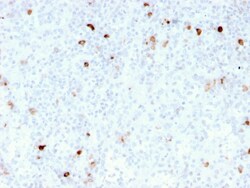
Biotium IgM (Immunoglobulin Mu Heavy Chain) (B-Cell Marker)(rIM260), CF647 conjugate, 0.1mg/mL
Recognizes a protein of 75 kDa, identified as mu heavy chain of human immunoglobulins. It does not cross-react with alpha (IgA), gamma (IgG), epsilon (IgE), or delta (IgD), heavy chains, T-cells, monocytes, granulocytes, or erythrocytes. This MAb is useful in the identification of leukemias, plasmacytomas, and certain non-Hodgkin's lymphomas. The most common feature of these malignancies is the restricted expression of a single heavy chain class. Demonstration of clonality in lymphoid infiltrates indicates that the infiltrate is clonal and therefore malignant. Primary antibodies are available purified, or with a selection of fluorescent CF Dyes and other labels. CF Dyes offer exceptional brightness and photostability. Note: Conjugates of blue fluorescent dyes like CF405S and CF405M are not recommended for detecting low abundance targets, because blue dyes have lower fluorescence and can give higher non-specific background than other dye colors.
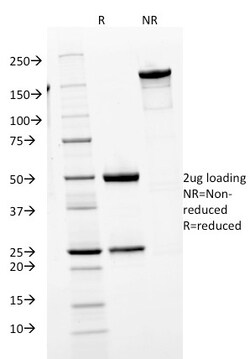
Biotium Human IgM (Immunoglobulin Mu Heavy Chain) (B-Cell Marker)(IGHM/1623), CF568 conjugate, 0.1mg/mL
Recognizes a protein of 75 kDa, identified as mu heavy chain of human immunoglobulins. It does not cross-react with alpha (IgA), gamma (IgG), epsilon (IgE), or delta (IgD), heavy chains, T-cells, monocytes, granulocytes, or erythrocytes. Monomeric IgM is expressed as a membrane bound antibody on the surface of B cells and as a pentamer when secreted by plasma cells. IgM antibody is prominent in early immune responses to most antigens. Aberrant levels are associated with immune deficiency states, hereditary deficiencies, myeloma, Waldenstrom's macroglobulinemia, chronic infection and hepatocellular disease. This MAb is useful in the identification of leukemias, plasmacytomas, and certain non-Hodgkin's lymphomas. The most common feature of these malignancies is the restricted expression of a single heavy chain class. Demonstration of clonality in lymphoid infiltrates indicates that the infiltrate is clonal and therefore malignant. Primary antibodies are available purified, or w
Miltenyi Biotec, Inc. CD90.2-APC, mouse, REA1167, 500 tests
Identification and enumeration of CD90.2+ cells by flow cytometry.
This product is subject to the following: Miltenyi Biotec, Inc. Terms and Conditions of Sale For Products and Services

Jackson Immuno Research Labs Cy3-AffiniPure F(ab')2 Fragment Mouse Anti-Rat IgG (H+L) (min X Hu Bov Hrs Ms Gt Rb Sr Prot)
Cy3-AffiniPure F(ab')2 Fragment Mouse Anti-Rat IgG (H+L) (min X Hu Bov Hrs Ms Gt Rb Sr Prot)

Jackson Immuno Research Labs Alexa Fluor 594-AffiniPure Mouse Anti-Rat IgG Fcγ Fragment Specific (min X Hu Bov Hrs Ms Sr Prot)
Alexa Fluor 594-AffiniPure Mouse Anti-Rat IgG Fcγ Fragment Specific (min X Hu Bov Hrs Ms Sr Prot)
Revvity Health Sciences Inc HTRF Human & Mouse Phospho-ATG14 (Ser29) Detection Kit, 50,000 Assay Points
HTRF Human & Mouse Phospho-ATG14 (Ser29) Detection Kit, 50,000 Assay Points

Jackson Immuno Research Labs Alexa Fluor 488-AffiniPure Mouse Anti-Rat IgG Fcγ Fragment Specific (min X Hu Bov Hrs Ms Sr Prot)
Alexa Fluor 488-AffiniPure Mouse Anti-Rat IgG Fcγ Fragment Specific (min X Hu Bov Hrs Ms Sr Prot)